The Developing Eight (D-8), comprising Azerbaijan, Bangladesh, Indonesia, Iran, Malaysia, Egypt, Nigeria, Pakistan, and Türkiye, occupies a strategic position in the global maritime landscape. These member states have direct access to major maritime domains, including the Atlantic Ocean, the Mediterranean Sea, the Indian Ocean, and the Pacific Ocean. Such geographic advantages provide substantial opportunities for advancing the blue economy across fisheries, marine resources, maritime logistics, ocean-based energy, and coastal and marine tourism.
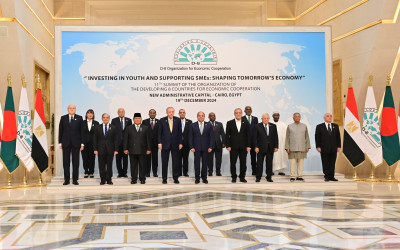
At the D-8 Summit in Cairo on 19 December 2024, Prabowo Subianto emphasized that the collective maritime potential of D-8 member states has not yet been fully optimized. He noted that the total global fisheries industry is valued at approximately USD 600 billion. Given the extensive coastlines and abundant marine resources across D-8 countries, a coordinated effort to maximize the blue economy could significantly strengthen the economic structures of member states.
Beyond sectoral potential, the D-8 represents one of the largest economic groupings among developing countries, with a combined Gross Domestic Product of approximately USD 4.81 trillion in 2023. Projections by international institutions indicate that most D-8 member states are expected to rank among the world’s 25 largest economies by 2050. This outlook reinforces the urgency of deepening economic integration, particularly in areas linked to maritime resources and sustainable ocean-based development.
Trade Integration and Blue Economy Infrastructure
The advancement of the blue economy is closely linked to stronger trade integration. President Prabowo has called for the effective implementation of the Preferential Trade Agreement (PTA) among member states, alongside the simplification of customs procedures to facilitate intra-D-8 trade. Efficient logistics systems and regulatory certainty are critical to enhancing the competitiveness of fisheries products, processed seafood, and other maritime commodities.
Strengthening the halal value chain also forms part of the broader integration strategy. With large Muslim populations across D-8 member states, halal standards and certification mechanisms are essential instruments for expanding market access, including for marine and fisheries products. An integrated halal value chain can support joint export initiatives while increasing product value addition across the bloc.
In the digital economy context, cross-border payment system interoperability will play a vital role in facilitating trade and marine tourism. The wider adoption of interoperable QR-based payment systems can simplify cross-border transactions for micro, small, and medium-sized enterprises (MSMEs), including those operating in fisheries, maritime services, and coastal tourism sectors.
Indonesia’s Chairmanship and the 2026 Summit Agenda
As Chair of the D-8 for the 2026–2027 period, Indonesia has placed the blue economy among its key priorities. Indonesia will host the D-8 Summit on 15 April 2026. Director General for Multilateral Cooperation at the Ministry of Foreign Affairs of the Republic of Indonesia, Tri Tharyat, underscored that the core mandate of the D-8 lies in economic cooperation and development, with a strong emphasis on concrete collaboration that delivers tangible benefits for communities and businesses.
Indonesia has committed to strengthening economic cooperation, trade, sustainable development, and the implementation of measurable programs. One of the flagship initiatives during its Chairmanship will be the D-8 Halal Expo, which is expected to feature more than 100 exhibitors. The Expo is designed as a platform to promote national products, including halal-certified fisheries and marine products, while facilitating business matching opportunities and expanding the recognition of halal certification through mutual recognition agreements among member states.
At the institutional level, Indonesia has proposed the establishment of a D-8 Disaster Resilience Network and a D-8 Halal Economy Center as legacy initiatives of its Chairmanship. These proposals are particularly relevant given that many D-8 member states are coastal nations vulnerable to natural disasters. Strengthening disaster resilience is essential to ensuring the sustainability of blue economy development.
The upcoming Summit is also expected to adopt the Jakarta Declaration, which will provide a shared policy direction on the blue economy, sustainable development, and institutional strengthening within the D-8 framework. Indonesia’s agenda extends beyond the Summit itself and will continue through the end of its Chairmanship on 31 December 2027, with sustained economic and development programs.
With its combined maritime resource potential, enhanced trade integration, strengthened halal economy networks, and coordinated policy frameworks, the D-8 member states are well positioned to elevate the blue economy as a pillar of long-term growth. While implementation challenges remain, a more integrated and results-oriented approach can generate concrete benefits for communities and businesses across the D-8 region.